 nacn.app
What kind of game is it?
Nostalgia Diary rolls time back to the year you started first grade. From there, you live through your school years one at a time until you graduate and head out into the working world. The English version lets you choose the country you went to school in: the United States (the default), the Philippines, Canada, Australia, or India. Each country has its own school system and its own trends from 1970 to 2025.
Pick your birth year and month, and the game works out when you started first grade using your country's school-year cutoff. In the United States, the game uses September 1: if you were born January through August, you started in the autumn of your birth year + 6; if you were born September through December, you started a year later. For example, born in June 1990, you started first grade in the autumn of 1996.
Each year shows what was big in your country that year: toys, video games and cartoons; music, TV and movies; fashion and fads; and the events everyone talked about. As you think "that came out that year?" and "what grade was I in then?", you choose how you spent each year and which path to take, and grow up all over again. One playthrough takes about 5 to 10 minutes.
How a game goes
- Getting started: Choose your country, your gender, and the year and month you were born. Gender only changes how your character looks (hair and clothes)
- One year per turn: From that year's trends, keep the one you remember most as your memory, then choose how you spent the year (study, sports, friends, or hobbies). The matching stat goes up by 2, and you move on to the next year
- Choosing your path: When you finish each stage of school (in the US: elementary school, Grades 1–5; middle school, Grades 6–8; and high school, Grades 9–12), you choose what comes next
- The ending: When you head out into the working world, you reach the ending, and your memories from every grade come together in a "life timeline"
Choose your country
On the start screen, choose the country you went to school in. The game pre-selects a country from your browser's region (for example, a browser set to English (Philippines) starts with the Philippines) and remembers your choice. You can also open the game with #ph, #ca, #au, or #in at the end of the address to start with that country. The study, sports, friends and hobby choices and the endings work the same way everywhere.
| Country | School years and cutoff | Paths |
|---|---|---|
| United States | Elementary Grades 1–5, middle school 6–8, high school 9–12. Cutoff September 1 | Public or private/magnet middle school; local or career and technical high school; four-year college, community college (2 years), or work |
| Philippines | Born 2000 or later (K-12): Elementary Grades 1–6, Junior High 7–10, Senior High 11–12. Born 1999 or earlier: 6 years of elementary and High School Year 1–4. Cutoff around September 1 | Local public high school or a science high school entrance exam; an academic strand (STEM, ABM or HUMSS) or the TVL track (K-12 only); college (4 years), a TESDA course (2 years), or work |
| Canada | Elementary Grades 1–6, junior high 7–9, high school 10–12. Everyone born in the same year starts Grade 1 together | Local junior high, or French immersion or a specialized school; academic or trades/technical programme; university (4 years), college (2 years), or work |
| Australia | Primary Years 1–6, high school Years 7–10, senior Years 11–12; the school year starts in late January or early February. Cutoff July 31 | Local public high school, or a selective school test or scholarship exam; Years 11–12 for an ATAR, VET subjects or a school-based apprenticeship, or leave for an apprenticeship or job; uni (3 years), TAFE (2 years), or work |
| India | Classes 1–5, Classes 6–10 (ending with the board exams), Classes 11–12; the school year usually starts in April. Cutoff March 31 | Local school, or the Jawahar Navodaya Vidyalaya / Sainik School test; Science stream, Commerce or Arts stream, or work; a college degree (3 years), an ITI or polytechnic diploma (2 years), or work |
Singapore isn't one of the playable countries, so if you're playing from Singapore, pick whichever of the five countries you went to school in, or the one whose trends you'd like to explore. If you don't choose, the game starts with the United States.
School systems vary by state, province and board, so the game uses a typical pattern for each country. Kindergarten and Prep/Foundation years aren't part of the game. Every country has its own trend timeline on the game's site: United States, Philippines, Canada, Australia, and India.
Features
Trends from 1970 to 2025, country by country
The trends and events in the game cover every year from 1970 to 2025, picked from four categories and dated by when they came out, premiered, or happened in the country you chose. In the United States, 1985 brought the NES with Super Mario Bros. and Back to the Future was the summer's hit movie; in 1998, Furby was the must-have Christmas toy and Pokémon arrived in the US; in 2007, Apple released the first iPhone; and in 2016, Pokémon Go sent everyone outside. Elsewhere, the Philippines' 1986 brings the EDSA People Power Revolution, India's 2000 brings the first season of Kaun Banega Crorepati, Australia's 2000 brings the Sydney Olympics and Cathy Freeman's 400 m win, and Canada's 2010 brings the Vancouver Winter Olympics. You can read everything in the game on each country's trend timeline (linked above), and every item links to Wikipedia.
A room that changes with the era, and a character who grows up
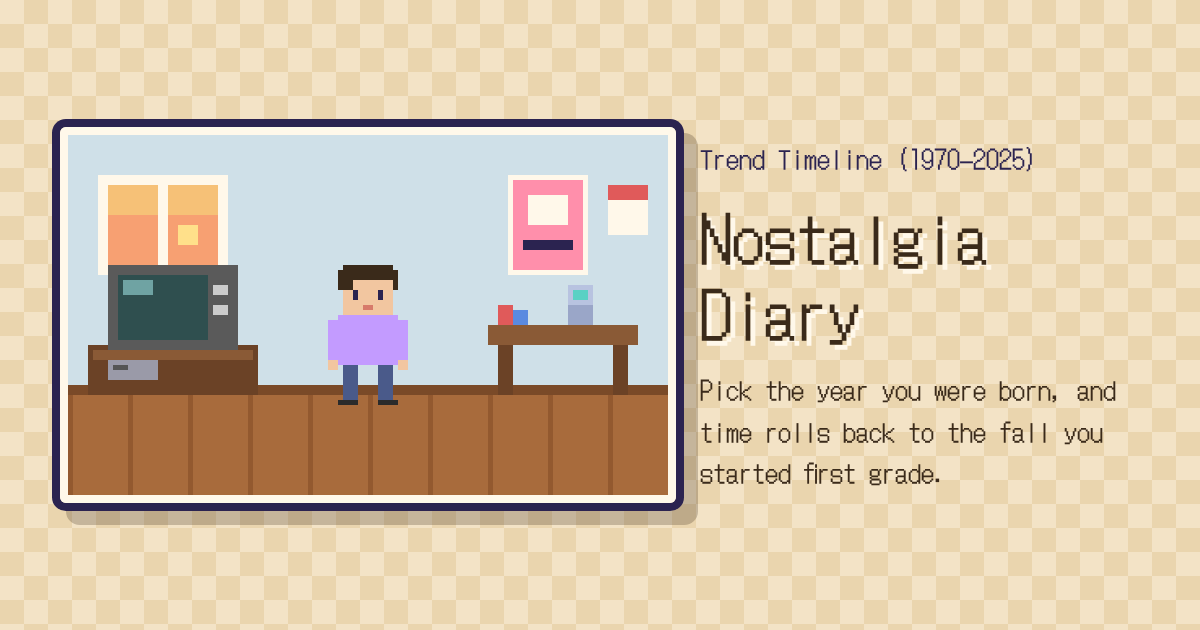
The TV in your pixel-art room changes from a tube set to a flat screen, the game console on the TV stand changes with the times, and the phone on your desk goes from a rotary phone to a push-button phone, a flip phone, and finally a smartphone. Your character carries a backpack in elementary school and gets taller in middle school. In the United States and Canada there are no school uniforms, so your character wears everyday clothes through high school; in the Philippines, Australia, and India, your character wears a school uniform from the end of elementary (primary) school through high school. As a grown-up, your character wears a suit.
Your path changes your ending
In the United States, the paths look like this (other countries are in the table above):
| When | Your choices |
|---|---|
| After elementary school (Grade 5) | The local public middle school / Apply to a private or magnet school (you need a Study stat of 6 or higher to get in) |
| After middle school (Grade 8) | The local high school / A career and technical high school |
| After high school (Grade 12) | A four-year college / Community college (2 years) / Start working |
In the United States, you turn 18 in Grade 12, register to vote, go to senior prom, and graduate in a cap and gown; in the other countries, you turn 18 in your first year after high school (College Year 3 under the Philippines' pre-K-12 system) and become old enough to vote (in India, you get your voter ID card). In every country, the entrance exam or selective school after elementary school takes a Study stat of 6 or higher. Your ending depends on the path you took into the working world and your highest stat (Study, Sports, Friends, or Hobbies). You get a title that fits your school years, like "The Steady Scholar," "The Go-Getter," "The Heart of the Group," or "The One Who Followed Their Passion," and if two or more stats tie for highest, "The Well-Rounded All-Rounder."
Compare notes with people from your generation
On the ending screen, the memory you kept from each grade and the paths you chose are lined up in your "life timeline." You can share your memories and your ending title on X or another app, or copy the text. Show it to friends born the same year, or to family from a different generation, and the "that was so big back then" stories start flowing.
FAQ
- Does it cost anything?
- No, it's free. There's no sign-up and nothing to install.
- Is my birth year sent anywhere?
- No. Your country, gender, birth year and month, and game progress are saved only in your browser.
- Which countries can I play as?
- The English version has the United States, the Philippines, Canada, Australia, and India, each with its own school system and trends. Singapore isn't one of them, but players in Singapore can pick any of the five on the start screen (the game starts with the United States unless you choose another). You can also add #ph, #ca, #au, or #in to the game's address.
- What birth years can I play with?
- You can choose a birth year from 1962 on. The game includes trends from 1970 to 2025, and other years move ahead with school events only. If you're younger, you get the "Caught Up to Today" ending once your grades move past the current year.
- My state or province used a different cutoff date. What should I do?
- Cutoff dates vary from place to place, and the game uses one typical date for each country (September 1 in the United States). If yours was different, choose a birth month that puts you in the right grade.
- Can I stop and pick up later?
- Yes. Your progress is saved automatically every year, so you can pick up where you left off with "Continue" the next time you open the game.
- Can I play in other languages?
- Yes. It's also available in Japanese, Traditional Chinese, Korean, Spanish, Portuguese (Brazil), and Indonesian. Each language uses its own country's school system and trends (Japan, Taiwan, South Korea, Mexico, Brazil, and Indonesia). Use the language links in the game to switch.
- I found a mistake in the timeline
- Please let us know through the contact form. Product and title names are trademarks or works of their respective owners, and the game names them only to describe what was popular that year.