nacn.app
How the three games differ
All three are about stopping at just the right moment, but what you're aiming for and how you play are different. Eyeball It and Sunny Side Up, Please are hold-to-play games: hold the button down and let go at the right time (Sunny Side Up, Please also has buttons to put a lid on the pan and flip the egg). Don't Ketchup the Fries! is a tapping game: hands reach in from every side of the screen, and you tap them to stop them.
| Eyeball It | Sunny Side Up, Please | Don't Ketchup the Fries! | |
|---|---|---|---|
| What you aim for | An exact amount (Soy sauce, Dry spaghetti, Cooked rice, Milk, Water in the pot) | The doneness and style they ordered (Runny, Jammy, Hard; sunny side up, basted, or over) | Which hands to stop and which to let through (4 kinds of hands) |
| Controls | Hold to pour, let go and that item is done (one shot each) | Hold to cook, use “Lid” or “Flip” if the order calls for it, then hit “Plate it” (you can press in short bursts) | Tap the hands reaching for the fries (several at once is fine) |
| One game | 5 items | 5 customers | No limit (until all 6 piles of fries have ketchup) |
| Play time | About 1 min | About 1 min | Depends on how long you last (about 1–2 minutes) |
| Scoring | 100 per item, minus 3 for every 1% off (500 max) | 100 per customer, minus 4 for every point off the target and up to 44 more for the wrong style (500 max) | +100 per hand stopped, +10 per second you hold out, and more |
| When it goes wrong | Overflow and that item scores 0 | Go past 100 heat and it burns: 0 points | Once all 6 piles have ketchup, happy hour is over |
| Once a day (set by the date) | “Today's 5” | “Today's Special” | “Today's Happy Hour” |
| As often as you like | “Practice” | “Practice” | “Practice” |
In Eyeball It and Sunny Side Up, Please, you see your result after each item or customer and move on when you're ready, so you can play at your own pace. Don't Ketchup the Fries! is the only one where the clock never stops. There's no time limit: it goes on until all 6 piles have ketchup, and as time goes on the hands get faster and more of them come at once, from 2 up to 8.
Which one should you play first?
New to the series? Start with Eyeball It
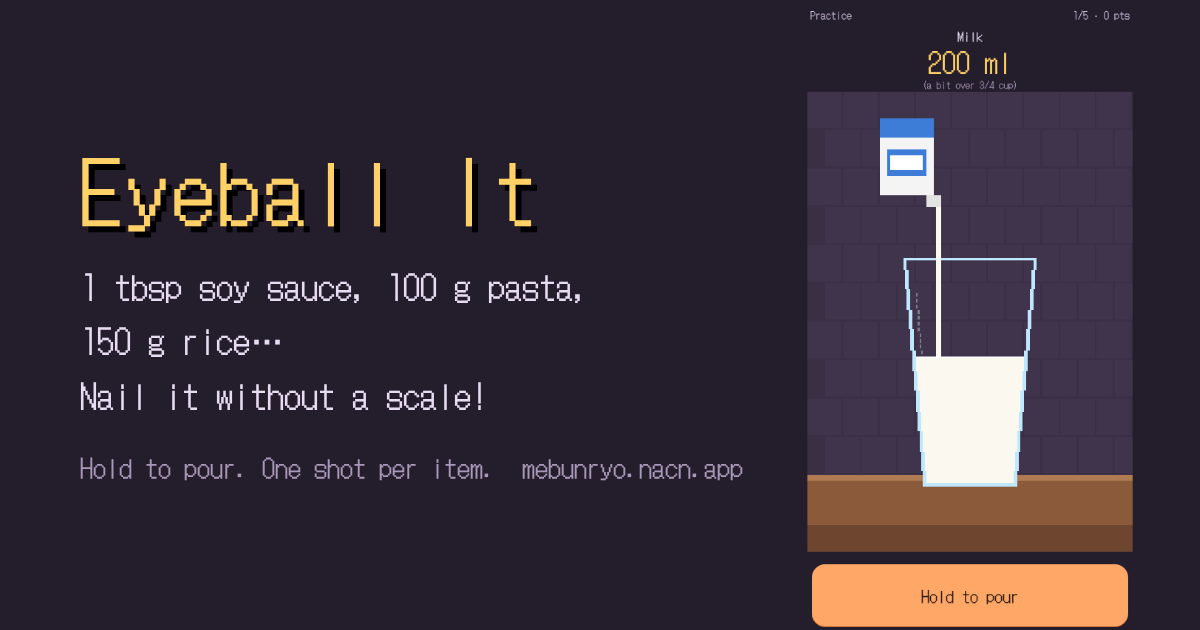
It's the first game in the series, and the easiest to pick up. Read the order, hold, let go. You press once per item, and you can see exactly how much is in the container as you pour. The amounts are everyday ones, like 1 tbsp of soy sauce or 150 g of rice, so if you cook a lot, it's fun to see how close your own sense of “about that much” really is.
Next, try Sunny Side Up, Please
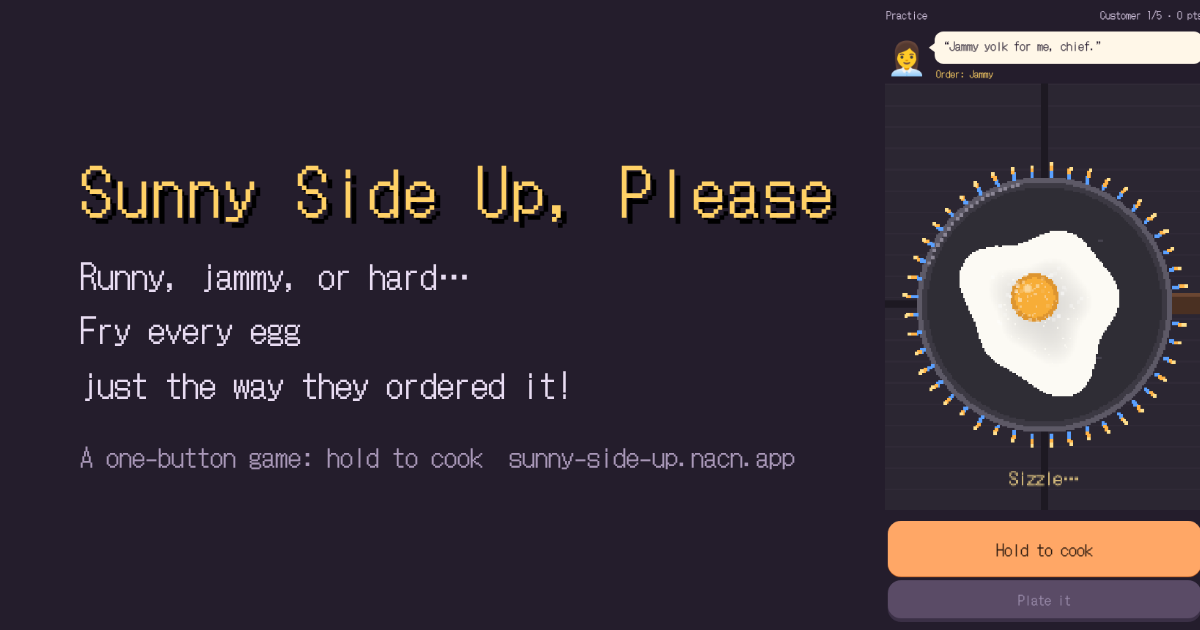
The second game uses the same idea as Eyeball It: hold the button and stop at just the right moment. The differences are that you can press in short bursts, the egg keeps cooking a little after you let go, no numbers ever show up on screen, and some orders have you cover the pan to steam the egg or flip it partway through. You judge doneness only by the color of the whites, the shine of the yolk, and the sound of the sizzle. Once you've got a feel for when to let go in Eyeball It, the differences really stand out.
Want a change of pace? Play Don't Ketchup the Fries!
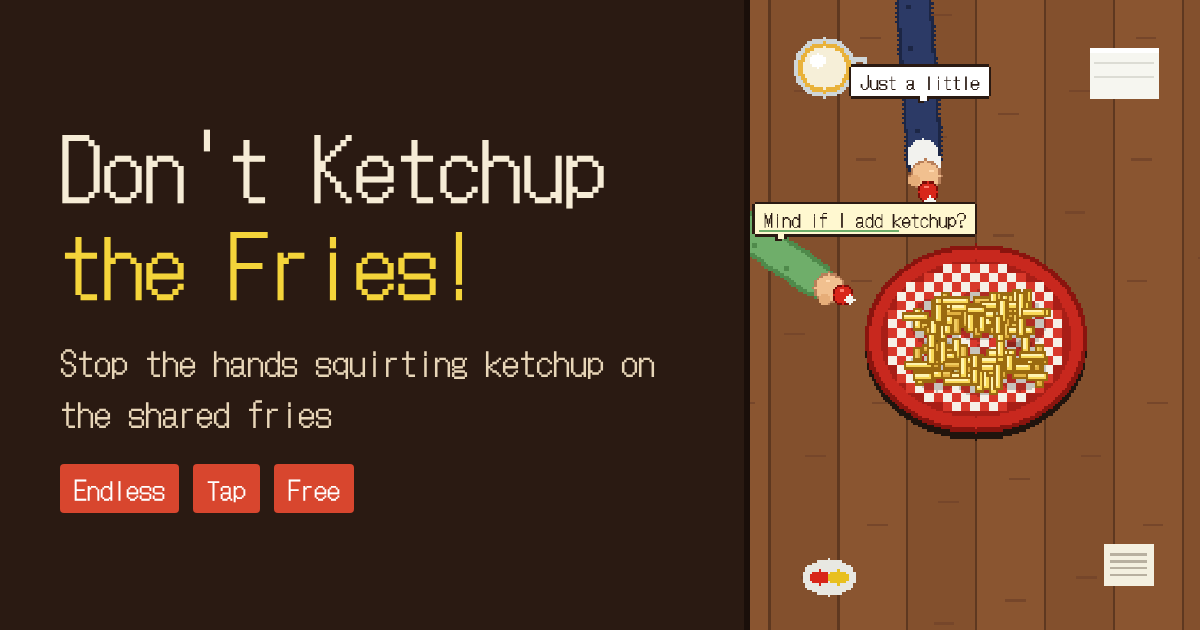
Don't Ketchup the Fries! plays completely differently: for as long as any fries are left clean, you keep tapping away the hands reaching for them. Where the other two are about watching closely and stopping on time, this one is about quick decisions. But the hand that asks “Mind if I add ketchup?” is the one you should let through, so tapping on reflex alone won't get you a high score.
All three have a once-a-day challenge, so even if you play every one of them every day, it only takes about 4 minutes in total.
The once-a-day challenge and practice mode
Each game has the same two modes.
- Daily challenge (once a day): “Today's 5” in Eyeball It, “Today's Special” in Sunny Side Up, Please, and “Today's Happy Hour” in Don't Ketchup the Fries!. It's set only by the date on your device, so everyone who plays on the same day gets the same items, the same orders, and the same hands coming in the same way. The first game you finish that day is your result for the day. If you pick it again on the same day, you won't play again; you'll see that day's result screen instead (and you can still share it)
- Practice (as often as you like): You get something new every time, and you can play as many times as you want
Your result shows up as a row of emoji, so you can compare with everyone who played the same daily challenge. Eyeball It uses 🎯🟢🟡🟠🔴 (💦 if it overflowed). Sunny Side Up, Please uses 🍳 for “Perfect!” and “So close!”, 🥚 for undercooked, 🔥 for overcooked or burnt, 🙃 for the wrong style, and 💥 for a yolk broken by flipping too early. Don't Ketchup the Fries! shows each pile you saved as 🍟 and each pile that got ketchup as 🍅.
A different dish in every country
Besides English, the kitchen series is playable in Japanese, Traditional Chinese, Korean, Spanish, Brazilian Portuguese, and Indonesian. The rules and scoring are the same in every language, but the wording and the food are changed to fit each country.
Eyeball It: measuring words and the coin by the spaghetti
The amounts (1 tbsp = 15 ml and so on) are the same in every language. What changes is how the measurements are written and the coin you compare the spaghetti to. Each coin is one close in size to Japan's 500-yen coin.
| Language | Title | How “1 tbsp” is written | Coin next to the spaghetti | Share to |
|---|---|---|---|---|
| Japanese | 目分量 | 大さじ1 (15ml) | 500円玉 | X |
| English (US) | Eyeball It | 1 tbsp (15 ml) | quarter | X |
| Traditional Chinese (Taiwan) | 目測大師 | 1大匙 (15ml) | 50元硬幣 | LINE |
| Korean | 눈대중 | 1큰술 (15ml) | 500원 동전 | X |
| Spanish (Latin America) | A Ojo | 1 cucharada (15 ml) | moneda de $10 | |
| Portuguese (Brazil) | No Olhômetro | 1 colher de sopa (15 ml) | moeda de R$ 1 | |
| Indonesian | Takaran Kira-Kira | 1 sdm (15 ml) | koin Rp1.000 |
Sunny Side Up, Please: the breakfast spot and the orders
The target doneness and the styles (lid and flip) are the same everywhere. What changes is how the orders are said (style names included), what the customers say, and how the sizzle is spelled out. Customers are picked the same way in every language too, so on any given day, “Today's Special” brings the same orders in the same order no matter which language you play in.
| Language | Title | Orders (runny / jammy / hard) | Styles (sunny side up / basted / over, jammy) | Daily mode |
|---|---|---|---|---|
| Japanese | 目玉焼き、半熟で | とろとろ / 半熟 / 固め | ふたなし / ふたあり / 両面焼き・半熟 | 今日の朝食 |
| English (US) | Sunny Side Up, Please | Runny / Jammy / Hard | sunny side up / basted / Over medium | Today's Special |
| Traditional Chinese (Taiwan) | 荷包蛋,半熟就好 | 蛋黃流心 / 半熟 / 全熟 | 不蓋鍋蓋 / 蓋鍋蓋燜 / 兩面煎・半熟 | 今日早餐 |
| Korean | 계란 프라이, 반숙으로 | 완전 반숙 / 반숙 / 완숙 | 뚜껑 없이 / 뚜껑 덮고 / 양면, 반숙 | 오늘의 아침밥 |
| Spanish (Latin America) | Huevo Estrellado, Tiernito | Tiernito / Término medio / Bien cocido | sin tapa / con tapa / Volteado, término medio | Desayuno de hoy |
| Portuguese (Brazil) | Ovo Frito, Gema Mole | Gema bem mole / Gema mole / Gema dura | sem tampa / com tampa / Virado, gema mole | Café da manhã do dia |
| Indonesian | Telur Ceplok Setengah Matang | Kuning meleleh / Setengah matang / Matang | tanpa tutup / ditutup / Dibalik, setengah matang | Sarapan Hari Ini |
Don't Ketchup the Fries!: every country's “don't put that on mine”
This is the game that changes the most. The original Japanese version is about the classic drinking-party argument over squeezing lemon on fried chicken. In each language, that's swapped for a “don't just put it on” fight people there know well, dish and all. Even the title is different in every country.
| Language | Title | What gets put on without asking | Sides |
|---|---|---|---|
| Japanese | レモン、かけないで | Lemon on karaage (Japanese fried chicken) | かける派 / かけない派 |
| English (US) | Don't Ketchup the Fries! | Ketchup on a shared basket of fries | Team Drizzle / Team Dip |
| Traditional Chinese (Taiwan) | 香菜,不要加 | Cilantro on yan su ji (Taiwanese popcorn chicken) | 香菜派 / 不要香菜派 |
| Korean | 소스, 붓지 마세요 | Sauce poured over tangsuyuk (Korean sweet and sour pork) | 부먹파 / 찍먹파 |
| Spanish (Latin America) | No le pongas piña | Pineapple on pizza | Con piña / Sin piña |
| Portuguese (Brazil) | Ketchup na pizza, não! | Ketchup on pizza | Time do Ketchup / Time Sem Ketchup |
| Indonesian | Jangan Diaduk! | Stirring bubur ayam (chicken porridge) | Tim Diaduk / Tim Tidak Diaduk |
A few short reads from the kitchen
Measuring by eye: 1 tbsp is 15 ml, a regular bowl of rice is 150 g
Eyeball It has these 5 items. The order is shuffled every game, and each amount is picked from the options for that item.
| Item | Possible amounts | Container |
|---|---|---|
| Soy sauce | 1 tsp (5 ml), 1/2 tbsp (7.5 ml), 1 tbsp (15 ml) | Tablespoon |
| Dry spaghetti | 70 g (2.5 oz), 80 g (2.8 oz), 100 g (3.5 oz · 1 serving), 120 g (4.2 oz), 150 g (5.3 oz · big serving) | Cutting board (with a quarter next to it) |
| Cooked rice | 100 g (small bowl), 150 g (regular bowl), 200 g, 250 g (big bowl) | Rice bowl |
| Milk | 120 ml (about 1/2 cup), 150 ml (about 2/3 cup), 200 ml (a bit over 3/4 cup), 250 ml (about 1 cup) | 300 ml glass |
| Water in the pot | 500 ml (about 2 cups), 800 ml (about 3⅓ cups), 1 L (about 1 quart), 1.5 L (about 1½ quarts) | 2 L pot |
1 tbsp = 15 ml and 1 tsp = 5 ml are the same as real measuring spoons. For rice, the game treats 100 g as a small bowl, 150 g as a regular bowl, and 250 g as a big bowl. For dry spaghetti, 100 g is one serving and 150 g is a big serving. In the game, a quarter sits next to the spaghetti, and a bundle as thick as the coin is about 100 g.
The pour speeds up while you hold the button, and it also changes by about ±30% from item to item, so counting seconds won't work. Soy sauce, milk, and water keep dripping a little after you let go. You lose 3 points for every 1% you're off, so if you miss by about 33.3%, that item scores 0. A “Spot on!” means you were within 2%.
Egg doneness: in the game, runny, jammy, and hard are 30, 50, and 75
In Sunny Side Up, Please, doneness is a number called “heat” that runs from 0 (raw) to 100 (burnt). The targets are 30 for Runny, 50 for Jammy, and 75 for Hard. The number never shows on screen, so you go by sight and sound.
- Around runny, the middle of the white is still clear and the yolk is glossy. The sound is “Tss”
- Around jammy, the white turns solid white and a patchy white film forms over the yolk. The sound is “Sizzle…”
- Around hard, the edge of the white turns brown and lacy, and the yolk goes pale and matte. The sound is “Crackle”
- Past 100, it burns. The sound is “Hisss…”
The white cooks faster toward the edge: the outermost ring cooks about 1.45 times as fast as the center. The heat of the burner changes from customer to customer, between 0.78 and 1.25 times the base, and once the egg is cooked, there's no going back. A “Perfect!” means you were within 2 of the target, and 25 or more off scores 0.
Each order also has a style. In each game, 2 customers want sunny side up, 1 wants basted, 1 wants it over, and the other 1 is random. With the “Lid” on, steam builds up and the burner gets up to 1.3 times as strong, and even with the burner off, the steam alone cooks about 0.8 heat per second and forms a white film over the yolk. After a “Flip”, the egg cooks 1.5 times as fast, but flip before 15 heat and the yolk breaks. The wrong style costs up to 44 points.
Dip or drizzle? Ask first
Whether to put ketchup on the shared fries is a classic argument. In Don't Ketchup the Fries!, you stop the hands that try to do it without asking. There are 4 kinds of hands: Coworker, Speedy intern, Pushy boss (it takes 2–3 taps to make them back off), and Polite coworker, who asks “Mind if I add ketchup?” and waits 1.6 seconds for an answer.
Stop the polite coworker and you lose 150 points. Let them through and you get +300 (and one pile gets ketchup). That brings the end a little closer, but the manner points are worth more, so letting someone who asked go ahead beats stopping them. Each second you hold out is worth +10, and your title depends on how long you last: hold out for 100 seconds or more and you're “Fry Guardian”. Stop the polite coworker 3 times or more, though, and you're “Courtesy Crusher”. Putting it on without asking is out, but asking first is fine. That's the idea behind the game. On the results screen, pick “Team Drizzle” or “Team Dip” and it goes into your share text as a hashtag.
The numbers on this page come straight from the code and data of the three games. The amount guides (such as a bundle as thick as a coin being about 100 g) and the heat numbers are rough guides made for the games, not real cooking advice. When you need an exact amount, use measuring spoons or a kitchen scale.
Play the kitchen series
Each game's page has an example game, tips, and an FAQ.