nacn.app
What kind of game is it?
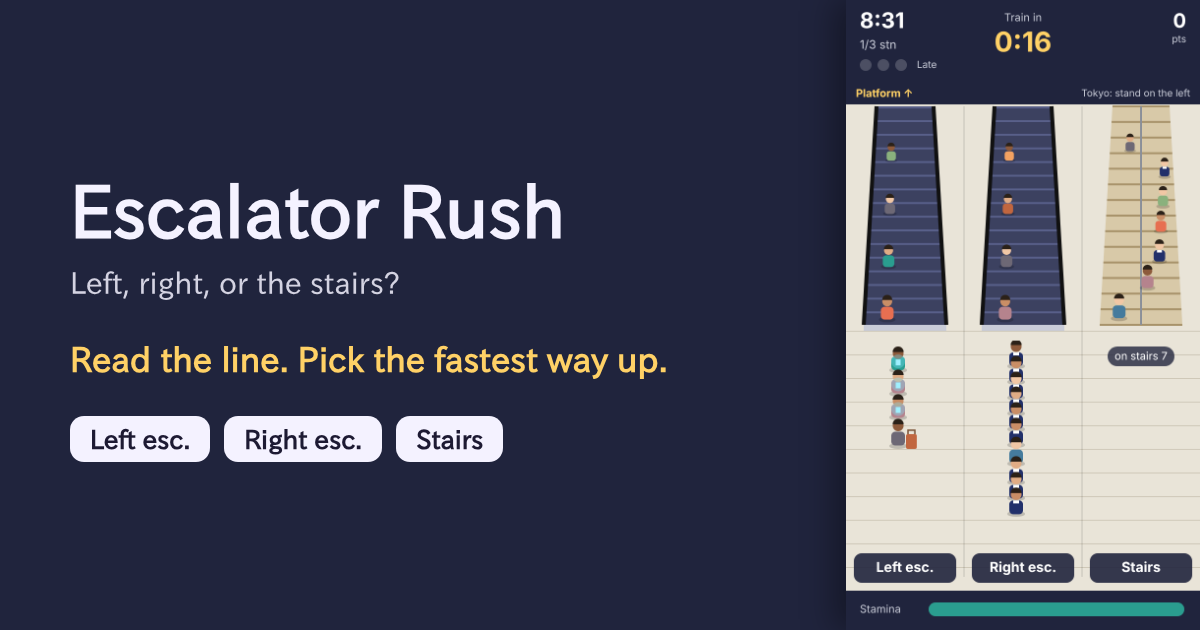
Escalator Rush turns the split-second "which line do I join?" decision that commuters make every morning into a game. The screen is split into three lanes: people lined up for the left and right escalators, and people climbing the stairs on the right. At the top you see the clock and a countdown like "Train in 0:16". Tap the route you think gets you up first before time runs out (3 seconds down to 1.2 seconds, depending on the stage). Hesitate and the crowd pushes you into the slowest route.
Once you choose, all three routes play out in fast-forward so you can see how many seconds each one took. After three to five choices at a station, you ride the train to the next one. Reach the station by your office and you clear the stage, with your arrival time, best-pick rate and a title.
Features
The short line is a trap: watch who is in it
An escalator takes the time everyone in line needs to step on, plus the ride itself (7 seconds at a normal station, 13 at a deep one). Both escalators are the same length, so the line alone decides which is faster. A regular commuter takes about 0.9 seconds to step on, but a phone zombie takes about twice that, a big suitcase about three times, and a lost tourist with a map about four times. A school group in matching uniforms, on the other hand, moves at about 0.45 seconds a person. A line of nine students often beats a line of three with a suitcase and two phones.
The stairs are a stamina game
Stair speed depends on how crowded the stairs are and on your stamina. Climbing drains stamina (even more at deep stations), and riding an escalator restores some. Low stamina can cut your stair speed in half, so taking the stairs again and again gets worse each time. Elderly people, strollers and hurried office workers jam the stairs, and on rainy days the steps are slippery and even slower.
Inspections, crowd waves and Osaka's stand-right rule
Later stages add a stopped escalator under inspection (you walk up it, a little slower than stairs), a train arriving mid-decision that makes every line grow, and a stand-on-both-sides campaign that speeds the lines up. In the Osaka stage, people stand on the right. The empty lane marked with footprints is for walkers; in this game you always stand still on escalators, so picking it costs you 50 points for bad manners.
Five stages plus Endless
Day One (1 station, 3 seconds) lets you decide by headcount alone. Weekday (3 stations, 2 seconds) adds phones, suitcases and groups; Rainy Monday (3 stations, 2 seconds) adds rain and crowd waves; Business Trip to Osaka (3 stations, 1.5 seconds) adds the stand-right rule and tourists; Fiscal Year-End (5 stations, 1.2 seconds) throws in everything with frequent inspections; and Endless keeps shrinking your time to decide. Picking the fastest route is a Best: 100 points plus 10 for each spare second, multiplied by your streak up to 2×. Making the train on a slower route is Safe (+50). Missing it scores 0 and pushes the clock 3 minutes forward. Three missed trains, or a clock past 9:00, ends the game.
Example: the first station of the Weekday stage
Here are the three choices at the first station of one Weekday run (start at 8:31, 3 stations). Who is in line changes every time. The seconds are the arrival times shown in the fast-forward after you choose.
| Choice | Who is in line | Seconds to arrive | Result |
|---|---|---|---|
| 1st (train in 16 s) | Left: 7 students and 2 commuters (9) / Right: a suitcase and 2 phone users (3) / Stairs: 4 people | Left 12.0 s, right 13.4 s, stairs 15.7 s | Took the longer left line: Best, +141 |
| 2nd (train in 17 s) | Left: 8 people incl. 2 suitcases / Right: 6 people incl. 3 suitcases / Stairs: 1 person | Left 17.6 s, right 17.5 s, stairs 12.7 s | Neither line would make the train, so the stairs: Best, +157 (streak 2). Stamina 100 → 70 |
| 3rd (train in 18 s) | Left: 4 students and 5 commuters (9) / Right: 2 suitcases, a phone user and a commuter (4) / Stairs: 7 people | Left 13.3 s, right 15.0 s, stairs 22.1 s | Left: Best, +176 (streak 3) |
That's 474 points for the first station. Taking the stairs on the 2nd choice dropped stamina to 70, so the crowded stairs on the 3rd choice were slower still. All three times, the escalator line with fewer people was not the fastest route.
Tips
- Scan each line for suitcases (brown), glowing phone screens and tourists with maps. A line with these is often slow even when it's short
- A cluster of students in navy uniforms moves fast, even when the line looks long
- Save the stairs for when they're nearly empty and your stamina is high. Using them back to back slows you down
- When "Train arriving!" appears, decide before the lines grow. And stay out of the empty walk lane
FAQ
- Is it free?
- Yes. No sign-up or app install needed.
- How long does a run take?
- About 60–90 seconds. Day One is three choices, about 20 seconds; Fiscal Year-End covers 5 stations and takes about a minute and a half.
- Can I play in other languages?
- Yes: Japanese, Traditional Chinese, Korean, Spanish, Portuguese (Brazil) and Indonesian. The rules and scoring are the same everywhere; the title and which side people stand on at the home station and on the business trip (right in Taipei, Seoul, Mexico City and São Paulo, left in Jakarta, and so on) are adapted to each country.
- Can I play on a computer?
- Yes. Click the left, middle or right of the screen, or use ← ↑ → (or 1, 2, 3) on your keyboard.
- Does it reflect real stations?
- No. All stations, people and timings are fictional and don't describe how crowded any real station is or how long it takes to get through. At real stations, stand still on escalators and follow the staff and signs.
- Is my data sent anywhere?
- Your best score for each stage, your sound setting and your play streak on the result screen are saved only in your browser. To understand how people play, the game sends Google Analytics the fact that you started and your result (stage, score, title, best-pick rate), but nothing that identifies you, like your name.
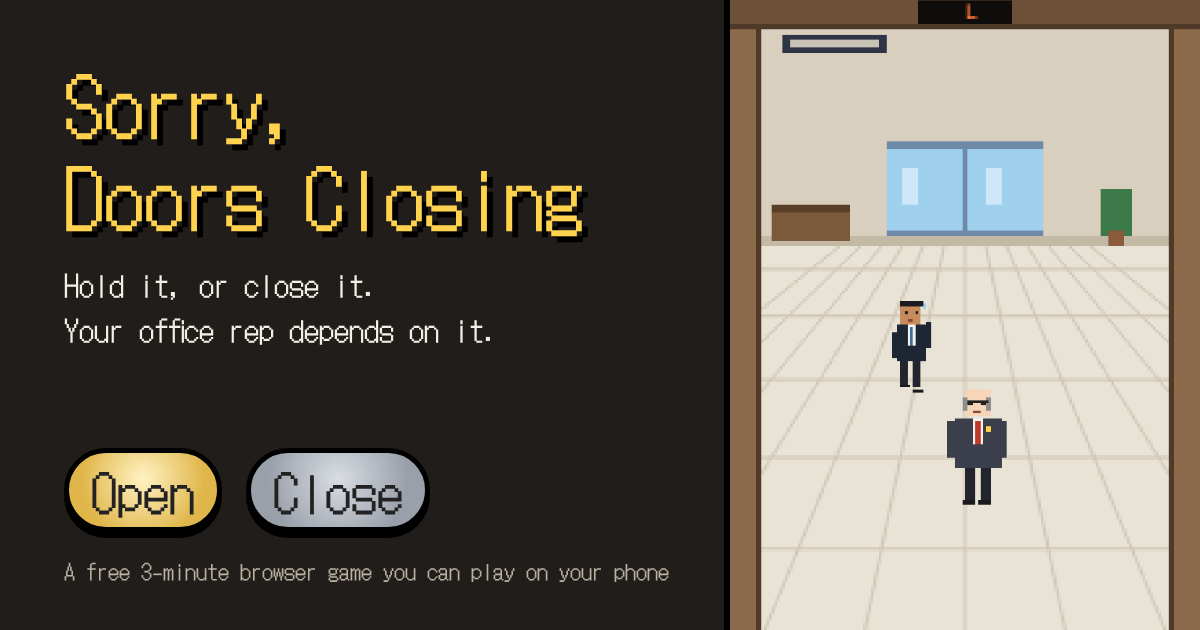
The game's How to play page has a table of how fast each kind of passenger is and how scoring works. Also try Sorry, Doors Closing, from the same morning-commute series.