nacn.app
What kind of game is it?
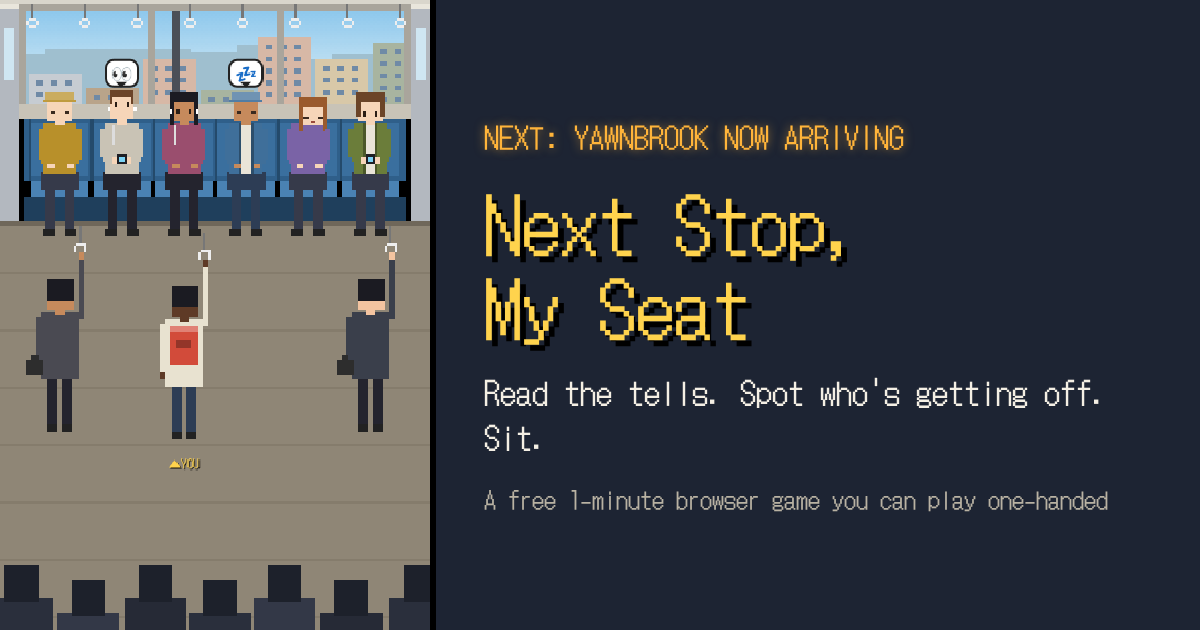
Next Stop, My Seat turns a tiny everyday contest into a game: on a crowded train, you guess “this person is getting off next” and go stand in front of them. Six riders sit in the row of seats, and during the 9 seconds between stations they do all sorts of things. When you spot someone who looks like they're getting off, tap their seat to move in front of them.
When the train stops, if the rider in front of you gets off, you sit and win the ride. If not, it's on to the next stop. You can sit at stops 1 through 4, and if you still don't have a seat when the train reaches stop 5, the end of the line, the ride ends with “Stood to the last stop”. You're not the only one after an empty seat, either. Two rivals in dark suits are watching the riders too, and a seat goes to whoever was standing in front of it first.
Features
Tells go from weak to medium to strong
A rider who's getting off shows stronger tells as the train nears the station. First come weak tells like 🧥 Buttons up coat or ⌚ Checks watch (about 1 to 3 seconds after leaving the station), then medium tells like 👀 Looks up at the station sign or 📱 Puts phone away (around 4 to 6 seconds), and right before the stop, strong tells like ❗ Starts to stand, then sits back down or 💼 Puts bag on lap and grips the handles (6 to 7 seconds). Anyone who shows a strong tell always gets off, but about 40% of the riders getting off never go past medium. Every tell pops up as a bubble over the rider's head, so you can read them even on a small screen.
Some riders look like they're leaving, but stay put
Someone sets their bag on their lap, then pulls out a book and starts reading (💼→📖). Someone looks up at the station sign, then closes their eyes again (👀→💤). Someone checks their watch and sighs because it's not their stop yet (⌚→💨). Each stop mixes in fake-outs like these that only give themselves away if you watch to the end. A rider who's fast asleep (💤) is going to miss their stop, so they won't get off. Riders who are staying sometimes button up their coat too, so don't make up your mind from a weak tell alone.
Moving takes time, and you have rivals
The carriage is packed, so moving one seat takes about 0.4 seconds, and going from one end to the other takes about 2 seconds. Your two rivals notice tells about 1 to 2 seconds after they appear, then move to the seat where the “getting off” tells have piled up. If you wait for a strong tell, a rival often gets there first, so the sooner you read the tells, the better. There's no shoving: a seat goes to whoever was standing in front of it first. But just standing there isn't enough: once the rider in front of you starts showing tells, move in front of that seat or tap the seat you're already at to get ready. If you don't, a rival who noticed the tells can cut in from the side. Rivals won't come to a seat you're ready for.
The earlier the stop, the higher the score, plus the same “Today's Line” for everyone
Sitting at stop 1 is worth 1000 points, stop 2 is 800, stop 3 is 600, and stop 4 is 400. On top of that you get a Waiting bonus: the number of seconds you were standing in front of the seat before the train arrived × 25 points (in steps of 10, up to 200 points). Your title is “Seat Prophet” for 1000 or more, “Commute Master” for 700 or more, “Pole Pal” for 1 or more, and “Standing Room Only” if you never got a seat. In “Today's Line”, every player gets the same stations, riders, and tells for that day, so you can tap “Share on X” and compare results with friends. “Practice” gives you different riders every time.
An example first stop
Number the seats 1 to 6 from the left, and say you board standing in front of seat 3 (the riders and their tells change every time). In this example, the rider in seat 4 gets off.
| After leaving the station | What happens in the seats | What you do |
|---|---|---|
| 0 s | The rider in seat 5 is fast asleep from the start (💤) | Wait and watch in front of seat 3 |
| 1.8 s | Seat 1 buttons up their coat (🧥), and seat 4 checks their watch (⌚) | Both are weak tells, so keep waiting |
| 3.9 s | Seat 3 looks up at the station sign (👀), but soon closes their eyes again (💤) | The rider in front of you probably isn't getting off |
| 4.4 s | Seat 4 looks up at the station sign (👀) | A medium tell after a weak one. Move one seat right and arrive in front of seat 4 at about 5.4 s |
| 5.1 s | Seat 2 also looks up (👀), then closes their eyes again | Stay put in front of seat 4 |
| 6.5 s | Seat 4 puts their bag on their lap and grips the handles (💼) | A strong tell. They're definitely getting off |
| 9 s (arrival) | The rider in seat 4 gets off | You were standing there first, so you sit |
You were in front of the seat about 3.6 seconds before arrival, so your Waiting bonus is 90 points. Your score is 1000 + 90 = 1090 points, and your title is “Seat Prophet”. If you wait for the bag tell (6.5 s) before moving, a rival may already be standing in front of seat 4 by then.
Tips for landing a seat
- Move when you see a medium tell like 👀 or 📱. A rider who shows a weak tell and then a medium one is much more likely to get off
- Keep watching after 💼. If they keep gripping the handles, they're getting off. If they pull out a book, it's a fake-out
- Skip riders who are fast asleep (💤). They're going to miss their stop, so they won't get off
- Don't move too much. While you're moving, you don't count as standing in front of any seat, and if you're still moving when the train stops, you lose your claim to that seat. Be in front of the seat 8 seconds before arriving and you get the full 200-point bonus
How this game came together
Reading who's about to get off
On a packed train, getting a seat comes down to spotting who's getting off at the next stop. In this game, riders who are getting off move through weak, medium and strong tells, and anyone who shows a strong tell always gets off. But there are fake-outs too, like someone who puts their bag on their lap and then starts reading, or looks up at the station sign and closes their eyes again. Weak tells like buttoning a coat sometimes come from people who are staying put.
Fixing "stand still and you'll sit half the time"
Letting the game play itself hundreds of times showed a problem in the first version: just standing there without doing anything got you a seat more than half the time (54 to 59%). Standing in front of a seat counted as "being there first," and rivals politely avoided that seat. So now, once the rider in front of you starts showing tells, you have to get ready by moving in front of that seat or tapping the seat you're already at. If you don't, a rival who noticed the tells can cut in from the side. After the change, doing nothing gets a seat 2% of the time and reading the tells gets one 98% of the time, so only players who read the riders sit down.
Made-up lines with sleepy names
Each country gets its own made-up train line and stations, all named after sleep: Yumemi Line in Japanese and the Daydream Line in English. Riders' looks are drawn from what's common in each country, while the rules and the emoji for each tell are the same everywhere.
FAQ
- Does it cost anything?
- It's free. No account or app install needed.
- How long does one ride take?
- Each stop is 9 seconds apart, so riding all the way to the end of the line takes about a minute, including time stopped at stations. If you sit at stop 1, it's over in about 15 seconds.
- Which languages can I play in?
- Seven: English, Japanese, Traditional Chinese, Korean, Spanish, Portuguese (Brazil), and Indonesian. The title and station names are adapted to each language, but the rules and scoring are the same, and “Today's Line” has the same riders and tells in every language.
- Can I play on a computer?
- Yes. Click a seat, or use the ← → keys, to move.
- Is it based on a real MRT line or train operator?
- No. The stations, line, carriages, and riders are all made up. On real trains, please give up your seat to those who need it more, especially the reserved seats.
- Is my data sent anywhere?
- Your personal best for each day's “Today's Line” and your personal best in “Practice” are saved only in your browser. To see how the game is played, it sends the start of a game and your result (score, the stop where you sat, and your title) to Google Analytics, but nothing that identifies you, such as your name.
For the full list of tells and how scoring works, see How to play on the game's site.