 nacn.app
What kind of game is it?
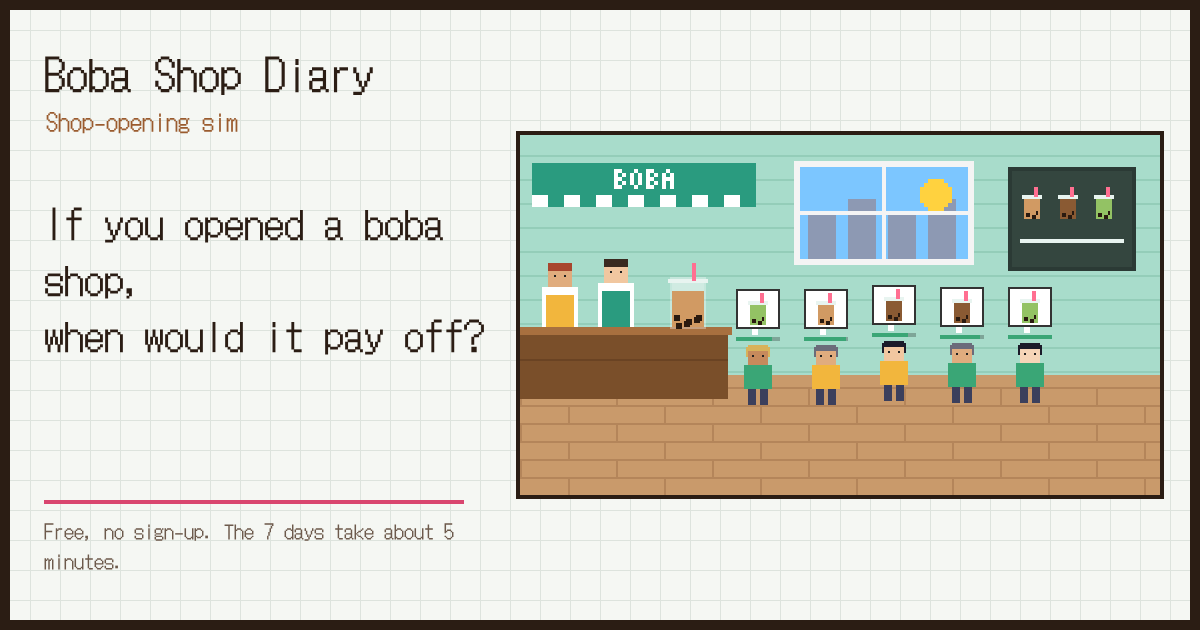
Boba Shop Diary is a simulation game where you open a small boba shop, run it for 7 days, and use the results to see how many months it would take to earn back your startup cost. Before opening, you choose a country and city, how much money you have, the location, whether to hire a part-timer, and your menu prices.
Each morning, you check the weather forecast and decide only one thing: how much boba to cook that day. Press "Open the shop" and the day runs by itself from 10:00 to 19:00 as customers line up at your pixel-art counter. At night, your sales, ingredient costs, rent, wages, and what customers said are written up in a diary. After day 7, you get the time to pay back your startup cost based on your average daily profit, along with business numbers like cost ratio, labor ratio, rent ratio, and operating margin.
Features
Your plan sticks with you for all 7 days
There are four locations: Station, College town, Tourist spot, and Residential. Station gets the most foot traffic (about 1.75 times Residential), but the startup cost and rent are high, and people in a hurry won't wait long. College town customers are tight with money, Tourist spot sells even at higher prices but empties out on rainy days, and Residential has fewer customers but lower costs and regulars who don't mind waiting. You also set staff and prices before opening, and you can't change them for 7 days.
For example, in Los Angeles with "Normal" money ($211,200), the startup cost is $110,880 in a Residential area, with rent of $107 a day. A Station spot costs $213,840 to open with rent of $285 a day, so you'd need "Plenty" of money to open there. Locations you can't afford are grayed out.
The daily decision: how much boba to cook
Boba is cooked in batches of 100 drinks and has to be used the same day. Leftovers are thrown out at closing, and if you run out, you close early. A heat wave brings 1.4 times the usual customers and rain brings 0.6 times, but the forecast is wrong about one day in four. On your own you can serve about 200 drinks a day; with a part-timer, about 400.
Prices and reputation drive your customers
The menu starts with Milk Tea and Brown Sugar Milk, and Matcha Latte joins on day 4. Charging more than the going rate brings in fewer customers, and charging far too much hurts your reputation. Your reputation (1 to 5 stars) moves with wait times and service, and each extra star brings 25% more customers. The line on screen holds 6 people; anyone else walks away. Each customer on screen stands for 10 people.
Every country and city plays differently
Choose from 35 cities in 10 countries and regions: Japan, Taiwan, Hong Kong, South Korea, Singapore, the Philippines, Malaysia, the USA, Spain, and Mexico. Currency, going rates, rent, wages, weather, and how price-sensitive customers are all differ, so the same 7 days can end very differently. Taiwan has lots of customers but low prices, while the USA has high prices but high rent and wages too.
An example week
Here's one example, starting in Los Angeles, Residential, with "Normal" money, no part-timer, and prices at the going rate (Milk Tea $6.50).
| Day | What happened |
|---|---|
| Day 1 | The first day is always sunny. You cook boba for 200 drinks to see how it goes. Reputation starts at 3 stars |
| Days 2–3 | Cloudy forecast. A few fewer customers, but nobody waited long, so your reputation went up |
| Day 4 | Matcha Latte is on the menu. The forecast said heat wave, so you cooked extra, and a line formed |
| Day 5 | You cooked less for a rainy forecast, but it stayed dry and you sold out in the early afternoon |
| Days 6–7 | Word got around and more customers came. Looking back on the week, the shop pays off in about 4 months |
The weather and customers change every time, so results vary from game to game even with the same choices. With these settings and boba for 200 drinks a day, the shop usually pays off in about 4 months. With "Plenty" of money at a Station spot and no part-timer, you can't keep up with the crowds and it takes about 8 months.
Tips
- Cook more on sunny and heat-wave days and less on rainy days. On some days, selling out costs you more than throwing a little away
- At busy spots like Station and Tourist spot, hire a part-timer, or the line overflows and your reputation drops
- Raise prices gently. 10% above the going rate costs you about 20% of your customers (more in College town and in price-sensitive countries)
- The results show projected monthly sales, cost ratio, and rent ratio, so try opening a few times with different choices and compare
FAQ
- Does it cost anything?
- No, it's free. There's no sign-up and nothing to install.
- How long does a game take?
- About 5 minutes for the 7 days. "Skip to closing" finishes a day right away.
- Can I use it to plan a real boba shop?
- It's a game that lets you try out, in simplified form, the real headaches of opening a shop: rent, wages, ingredient costs, and how the weather changes your customers. The amounts are estimates for the game and don't include your own salary or utilities. If you're planning a real shop, talk to a professional.
- Can I share my results?
- Yes. The results screen makes an image with your payback time and rank that you can share or save.
- Is my data sent anywhere?
- No. Your personal best and the country you chose are saved only in your browser.